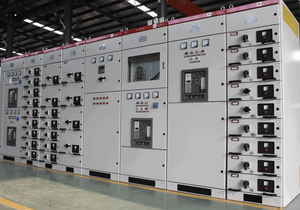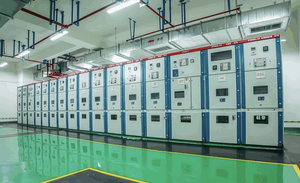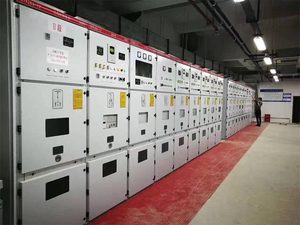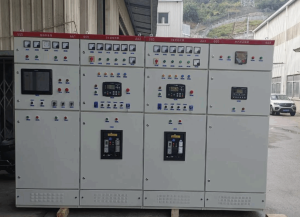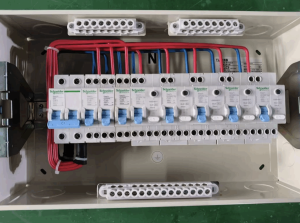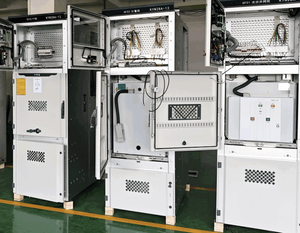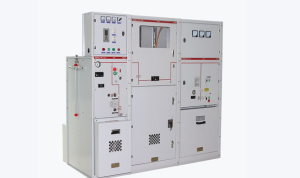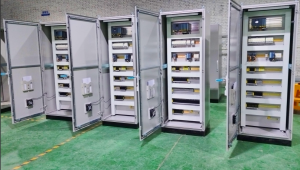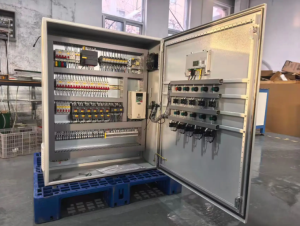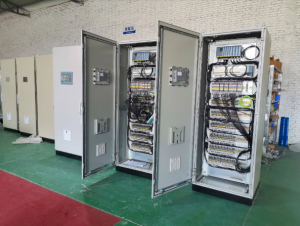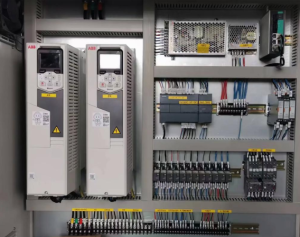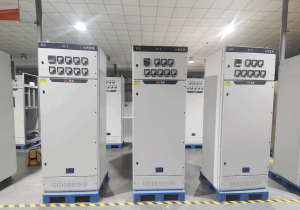
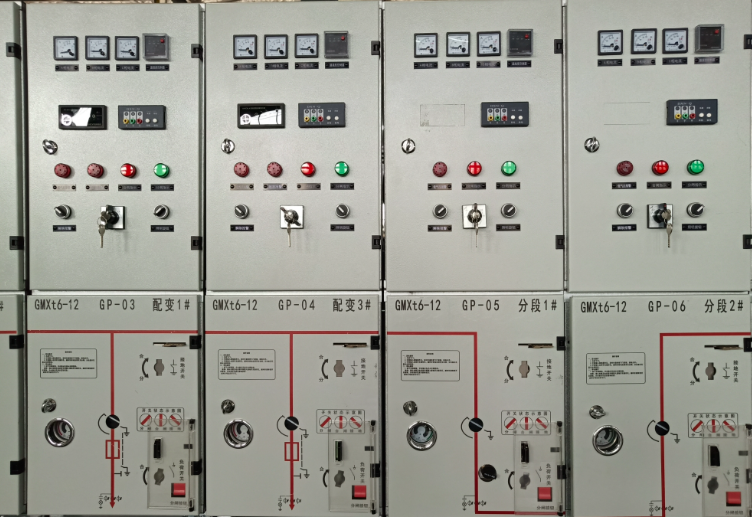
Air Insulated Switchgear, abbreviated as AIS, is core high-voltage and medium-voltage switchgear in power transmission and distribution systems. It mainly adopts atmospheric air as the primary insulation and auxiliary arc-extinguishing medium. With an open or metal-enclosed structure, it realizes switching on, switching off, isolation and fault protection of power circuits. As a traditional and technically mature power distribution device, AIS is widely applied in substations of power grids at all levels, power distribution for industrial plants, new energy power stations and power supply systems of public infrastructure. It serves as critical equipment for the safe and stable operation of power systems.
Working Principle and Structure of Air Insulated Switchgear (AIS)
1.1 Core Working Principle
The core operation logic of AIS relies on the coordination of air insulation properties and mechanical switching mechanisms. Under atmospheric pressure, air features stable insulation and voltage-withstand capacity, which can effectively isolate live conductors, busbars and various switch components to prevent short-circuit discharge faults between phases and between phases and ground.
During normal equipment operation, the closing mechanism keeps the circuit conductive to guarantee stable power delivery. When abnormal faults such as overload, short circuit and electric leakage occur in the power system, built-in protection devices respond rapidly to drive circuit breakers to open, cut off faulty circuits and restrain arc spread, so as to avoid safety accidents including equipment burnout and power grid paralysis. After troubleshooting, closing reset can be completed manually or automatically to restore power supply.
1.2 Core Components
A complete set of AIS consists of multiple core components that work together to ensure stable equipment operation. The key components are listed as follows:
- Vacuum Circuit Breaker: The core switching and protection component. It undertakes normal circuit switching and rapid fault breaking, adopting vacuum arc-extinguishing technology with high arc extinction efficiency and low loss.
- Disconnector: Provides a visible physical break point. It completely isolates circuits during equipment maintenance to protect the personal safety of operation and maintenance personnel.
- Current and Voltage Transformers: Collect real-time operating parameters of power grids to provide accurate data support for protection and monitoring systems.
- Busbar System: Takes charge of power transmission and distribution, acting as the core carrier of power flow inside the equipment.
- Enclosure and Protection Structure: Indoor units adopt metal-clad enclosed cabinets with excellent dustproof and moisture-proof performance. Outdoor units are equipped with windproof, lightning-proof and anti-pollution structures to adapt to complex outdoor working conditions.
Classification of Air Insulated Switchgear (AIS)
Based on differences in voltage level, installation scenario and structural form, AIS can be divided into multiple sub-types to meet customized demands of various power projects. The mainstream classification methods are as below:
2.1 Classification by Voltage Level
- Medium-Voltage AIS: Covers a voltage range of 3.6kV to 24kV. As the most widely used model, it is mainly applied to industrial power distribution, new energy power stations, urban distribution networks and power supply for commercial complexes.
- High-Voltage AIS: Covers a voltage range of 70kV to 250kV, mostly used for regional main power grids, large and medium-sized substations and supporting projects of cross-provincial power transmission.
- Extra-High-Voltage AIS: Adapted to power transmission scenarios above 250kV, serving large power hubs and long-distance power transmission engineering projects.
2.2 Classification by Installation Mode
- Indoor Enclosed AIS: Adopts a metal-clad enclosed structure with compact size and strong protection performance, featuring outstanding dustproof and moisture-proof effects. It applies to indoor scenarios such as factory power distribution rooms, indoor substations and data centers.
- Outdoor Open-Type AIS: Features an open structure with excellent heat dissipation. Suitable for open outdoor sites, it is equipped with windproof, lightning-proof and anti-corrosion functions, widely used in field substations and centralized photovoltaic and wind power stations.
Comprehensive Comparison between AIS and GIS Switchgear
GIS (Gas Insulated Switchgear) is the primary competing device of AIS. Although they share identical core functions, they differ greatly in insulation medium, structural size, cost and applicable scenarios, which are key comparison dimensions for equipment selection in power projects.
| Comparison Dimension | Air Insulated Switchgear (AIS) | Gas Insulated Switchgear (GIS) |
| Insulation Medium | Atmospheric air, no chemical gases, eco-friendly | SF6 gas with excellent insulation performance, categorized as a greenhouse gas |
| Structural Size | Large overall volume, wide floor space and scattered layout | Compact structure, covering only 1/3 to 1/5 of the floor space of AIS |
| Construction Cost | Low equipment procurement and installation costs with high cost performance | Highly sophisticated equipment with high overall cost and strict installation process requirements |
| Maintenance Difficulty | Intuitive structure with visible faults, convenient inspection and low maintenance costs | Fully enclosed structure, difficult fault diagnosis requiring professional testing equipment and high maintenance costs |
| Environmental Adaptability | Susceptible to pollution, humidity and extreme weather, with limited adaptability to harsh working conditions | Fully enclosed protection, free from external environmental interference and suitable for harsh working conditions |
| Service Life | Standard service life of 20 to 25 years | Standard service life of 30 to 40 years with superior equipment stability |
| Applicable Scenarios | Power distribution and substation projects with sufficient site space and limited budget under conventional working conditions | Key projects in urban core areas with limited site space, harsh environments and high power supply reliability requirements |
Advantages and Disadvantages of Air Insulated Switchgear (AIS)
4.1 Core Advantages
- Eco-friendly and pollution-free: Air serves as the insulation medium throughout operation without greenhouse gases such as SF6, eliminating risks of gas leakage and complying with the green and low-carbon development trend of the power industry.
- High overall cost performance: Mature manufacturing techniques lower procurement costs. The installation and commissioning process is simple without complicated gas detection and sealing maintenance procedures. Both upfront investment and subsequent operation and maintenance costs are far lower than those of GIS.
- Convenient operation and maintenance: The open and intuitive equipment structure allows direct observation of fault points. Daily inspection, component replacement and troubleshooting do not require sophisticated precision equipment, resulting in a low maintenance threshold.
- Mature technology with high reliability: Decades of industrial application and iteration have formed a complete technical system. It adapts to most conventional power working conditions with low operating failure rates, and its stability has been verified by the market.
- Flexible adaptability: A full range of models covers scenarios from low-voltage power distribution to high-voltage power transmission, with customizable indoor and outdoor equipment according to project requirements.
4.2 Drawbacks
- Large floor space: Dependent on air insulation clearance, the equipment features a scattered layout and bulky overall volume, making it unsuitable for power projects in urban core areas with limited land resources.
- Weak environmental interference resistance: Its insulation performance is vulnerable to harsh environments including coastal salt fog, heavy industrial pollution, high altitudes and heavy sandstorms, requiring additional protective treatment.
- Limited insulation performance: Air has lower insulation strength than SF6 gas. Under the same voltage level, higher safety clearance is required, making ultra-compact design impossible.
- Frequent maintenance for outdoor operation: Long-term exposure to natural environments leads to dust accumulation and corrosion, calling for regular cleaning and inspection more frequently than enclosed equipment.
Applications of Air Insulated Switchgear (AIS)
Benefiting from high cost performance, easy maintenance and wide adaptability, AIS is extensively adopted in various power transmission, distribution and consumption projects worldwide. Its core application scenarios include:
- Substations of all power grid levels: Conventional urban and rural substations, regional distribution stations and township power grid upgrading and reconstruction projects. It acts as the primary core equipment for basic power grid distribution.
- Industrial production power distribution systems: Medium and high-voltage power distribution systems for factories, mines and manufacturing parks to meet the demand for continuous and stable industrial power supply.
- New energy power generation projects: Centralized photovoltaic power stations, onshore wind farms and energy storage power stations, matching power transmission and grid connection demands of new energy sources.
- Public infrastructure: Power distribution systems for rail transit, large commercial complexes, hospitals, schools and data centers to guarantee stable power supply for public livelihood.
- Power engineering in remote areas: Power transmission projects in wild and remote regions. It adapts to sites with sufficient space and limited maintenance conditions to cut construction and operation costs.
Operation and Maintenance Specifications for AIS
Standardized operation and maintenance management can greatly improve the operational stability and extend the service life of AIS. Maintenance work falls into two categories: daily patrol inspection and periodic overhaul.
Daily maintenance mainly includes equipment surface cleaning, cabinet tightness inspection, temperature detection of wiring terminals and visual inspection of insulation status. Dust and debris accumulated on the equipment surface shall be cleared timely to avoid insulation performance degradation caused by pollutant buildup.
In-depth periodic maintenance shall be carried out on a regular cycle, covering circuit breaker switching performance testing, disconnector contact condition inspection, transformer parameter calibration, grounding system reliability testing and insulation resistance measurement. Meanwhile, wear and aging of mechanical components shall be checked, and worn parts replaced promptly to eliminate potential faults. Additional patrol inspection against lightning, corrosion and water ingress shall be performed for outdoor AIS, with special inspections arranged after extreme weather.
Selection Guide for Air Insulated Switchgear
Selection of AIS for power projects shall be determined comprehensively based on actual working conditions. Key selection factors include project voltage level, installation site space, on-site environmental conditions (pollution grade, altitude, temperature and humidity), project budget, later maintenance capacity, load capacity and power supply reliability requirements.
General selection principles: Prioritize AIS for projects with sufficient site space, limited budgets and conventional indoor and outdoor working conditions. For key projects with limited land, harsh environments, extremely high power supply reliability requirements and sufficient long-term maintenance budgets, GIS shall be selected as an alternative. Besides, equipment with corresponding protection grades shall be matched according to on-site pollution levels. AIS with composite insulation structures and high creepage distances are preferred for coastal and heavily polluted areas.
Frequently Asked Questions
8.1 What are the core differences between AIS and GIS switchgear?
The core differences lie in insulation medium, structure and cost. AIS uses air as the insulation medium with large volume, low procurement cost and simple maintenance. GIS adopts SF6 gas for insulation, featuring a compact structure and strong environmental adaptability, yet higher procurement and maintenance costs, suitable for high-end harsh working conditions.
8.2 Is AIS more cost-effective than GIS?
For projects under conventional working conditions with sufficient site space, AIS delivers far higher overall cost performance, with lower upfront equipment procurement, construction and long-term maintenance costs. However, for key projects with limited land and harsh environments, GIS boasts superior stability and long-term performance with higher whole-life cycle value.
8.3 Should AIS or GIS be adopted for substation projects?
AIS is prioritized for conventional substations in suburban, township and open-field areas to balance performance and cost. GIS is preferred for hub substations in urban core areas with tight land supply and high reliability requirements to overcome space and environmental constraints.
Conclusion
As classic core equipment in power transmission and distribution, Air Insulated Switchgear (AIS) holds an irreplaceable position in all types of conventional power projects thanks to its mature technology, eco-friendly features, high cost performance and easy maintenance. Despite its drawbacks of large floor space and mediocre adaptability to harsh environments, AIS remains the optimal selection for most power grid, industrial, new energy and public infrastructure projects with adequate site space and controllable budgets.
In practical project implementation, reasonable comparison of performance between AIS and GIS based on working conditions, space constraints, budget and maintenance demands, together with accurate equipment selection, standardized installation and periodic maintenance, can maximize the safe, stable and economical long-term operation of power systems.
References
- IEC 62271 High-voltage switchgear and controlgear – General specifications
- IEC 60694 Common specifications for high-voltage switchgear and controlgear standards
- GB/T 11022 Common technical specifications for high-voltage switchgear and controlgear